


Choose the Best Lithium Battery Making Machine Options
Modern gigafactories and advanced laboratories demand absolute precision during electrode manufacturing.
Investing in a reliable lithium battery making machine determines long-term cell energy density and safety performance.
This cell production machinery must compact fragile slurry coatings onto thin metallic foils smoothly.
Furthermore, high-precision engineering guarantees strict lead-free compliance and complete regional safety standards.
Exploring our comprehensive technical guide reveals vital pressure controls and roller alignment specifications.
Consequently, buyers secure cost-effective equipment that maximizes yield without compromising production quality.
High-Precision Cell Manufacturing Challenges
Insufficient Active Material Density and Bonding
Freshly coated electrode sheets contain microscopic air gaps between active particles after drying.
Weak particle compaction leads to poor physical adhesion between active materials and metallic foils.
Consequently, active materials delaminate during high-speed downstream cell winding or flat stacking operations.
Inadequate bonding increases internal resistance and degrades overall electrochemical cell performance over time.
Deploying dedicated rolling equipment compacts active coatings to optimal target density effortlessly.
Inconsistent Thickness and Surface Waves
Unstable mechanical roller pressure produces uneven thickness variations across wide electrode sheets.
Varying foil thickness creates localized stress points that cause physical wrinkling and edge waves.
Consequently, wavy electrodes disrupt automated stacking processes and lower overall battery safety margins.
Precision pressure control systems maintain uniform micrometer-level thickness tolerances across entire rolls.
Smooth, flat electrode plates ensure seamless downstream assembly and reliable long-term battery performance.
High Equipment Costs for Small-Scale Lines
Emerging battery labs and pilot lines face severe budget constraints during initial setup.
Industrial-scale manufacturing equipment often requires massive capital expenditure and excessive floor footprint space.
Consequently, research facilities struggle to acquire reliable equipment for small-scale testing and production.
Selecting compact, high-precision machinery provides an ideal cost-effective alternative for developing laboratories.
Budget-friendly rolling equipment delivers premium industrial-grade manufacturing quality at accessible price points.
Technical Features of the Electrode Roller Pressing Unit
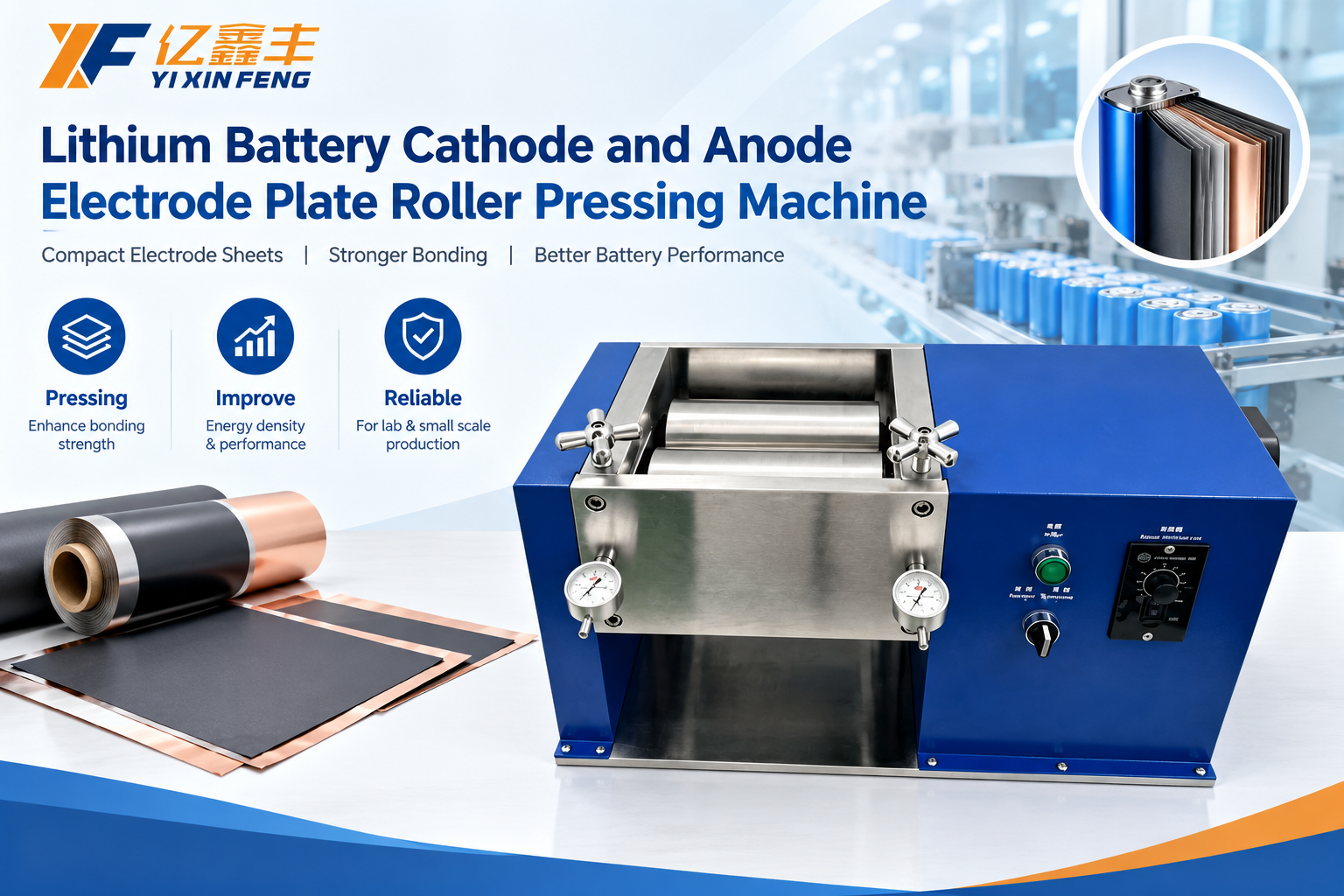
Our Lithium Battery Cathode and Anode Electrode Plate Roller Pressing Machine delivers exceptional pressing performance.
This specialized unit compacts coated and dried cathode and anode sheets with remarkable mechanical accuracy.
By compacting active materials, it enhances physical bonding strength between chemical layers and metallic foil substrates.
Consequently, the increased coating density boosts overall volumetric cell energy density and chemical efficiency.
We specially recommend this model for laboratory testing, pilot research, and small-scale battery production lines.
Built with high-grade alloy steel rollers, this unit provides exceptional wear resistance and long operational life.
Precision adjustment mechanisms allow operators to control roller gaps with micrometer-level accuracy continuously.
Furthermore, the machine operates with high mechanical stability, preventing foil tearing or surface scratching.
Its compact footprint and intuitive controls minimize setup times while optimizing daily lab workflow productivity.
Offering premium performance at an affordable cost, this machine delivers unbeatable value for growing facilities.
Equipment Specification & Performance Comparison Matrix
The table below outlines key parameters for our electrode rolling equipment series:
|
Equipment Specification |
Lab Benchtop Pressing Unit |
Pilot Line Roller Press |
Industrial Continuous Calender |
|
Primary Application |
Lab R&D / Small Scale |
Pilot Battery Lines |
High-Volume Gigafactories |
|
Target Material |
Cathode & Anode Plates |
Cathode & Anode Plates |
Continuous Electrode Coils |
|
Roller Diameter |
100 mm – 150 mm |
200 mm – 300 mm |
> 500 mm |
|
Thickness Tolerance |
±0.002 mm |
±0.0015 mm |
±0.001 mm |
|
Cost-Efficiency Level |
Extremely High |
High |
Moderate (High CAPEX) |
|
Machine Footprint |
Compact Benchtop |
Medium Floor Unit |
Large Integrated Line |
|
Safety Compliance |
CE, Lead-Free Compliance |
CE, Lead-Free Compliance |
CE, Lead-Free Compliance |
Explore complete equipment options on our product-category page today.
Key Factors Buyers Must Evaluate
Selecting a versatile lithium battery making machine requires careful technical evaluation across core parameters.
Roller Rigidity and Hardness: Choose rollers made from premium treated alloy steel to resist deformation under heavy continuous load.
Pressure Precision Control: Ensure the machine offers fine micrometer adjustments for accurate thickness management across diverse slurry chemistries.
Build Quality vs. Cost: Look for robust mechanical construction that delivers long-term durability without inflated enterprise price tags.
Maintenance and Ease of Use: Select user-friendly equipment with easily accessible components to simplify routine cleaning and calibration.
Questions and Answers
Q: Why is electrode roller pressing essential in battery manufacturing?
A: Roller pressing compacts coated electrode materials to increase particle density and strengthen bonding to metallic foils. This process reduces internal electrical resistance, boosts volumetric energy density, and improves overall battery life.
Q: Is this roller pressing machine suitable for university labs and R&D centers?
A: Yes, this model is designed specifically for laboratory testing, pilot research, and small-scale battery manufacturing lines. It offers industrial-grade precision in a compact, highly cost-effective package.
Q: How does this machine maintain high performance while remaining budget-friendly?
A: By focusing on core pressing functionality and robust mechanical engineering, we eliminate unnecessary complexity. This smart design delivers high quality, exceptional accuracy, and long-term durability at a competitive price.